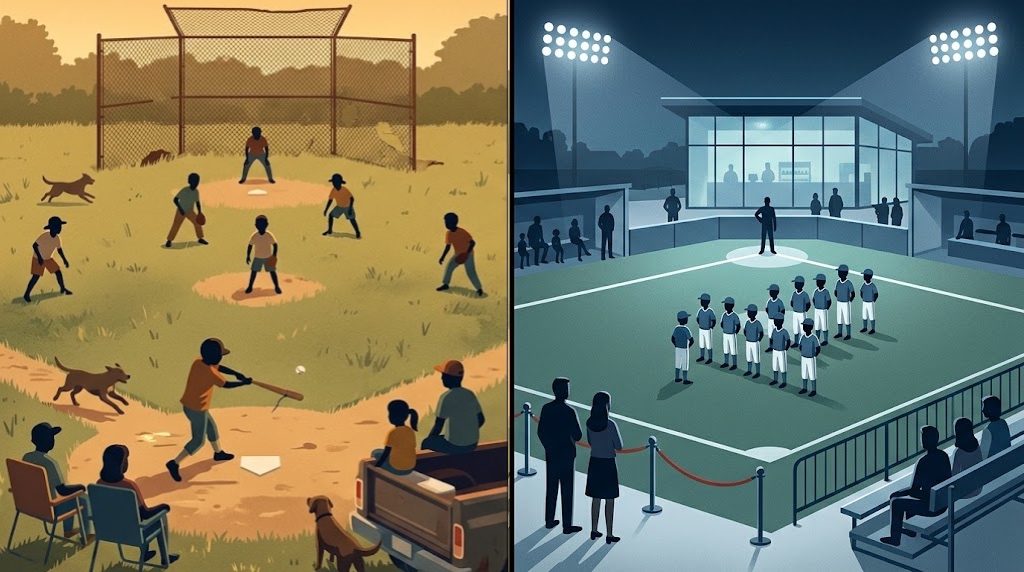
There's a phrase getting used to describe what's happening in America right now: bifurcation. One track heading toward Luxe. One track sinking into Despair. It sounds like two roads diverging — two Americas drifting apart, side by side, each minding its own lane.
That's not what's happening. It isn't two tracks running parallel. It's one track feeding the other.
The Despair Economy is the larger of the two by an enormous margin — it's the base of the pyramid, the 44% of adults who say they can't comfortably afford health care, the 41% carrying medical debt, the families skipping club soccer contracts they can't pay off. The Luxe Economy is smaller, sitting on top, extracting fees, seat licenses, and premium margins. The relationship between them isn't proximity. It's supply chain. The scale of the Despair Economy is the balance sheet the Luxe Economy draws from. Every hidden fee, every seat license, every 46% spike in youth sports costs — none of it exists without millions of people paying more than they can afford so a much smaller number of capital holders hit a return target.
That's not a metaphor. It's a mechanism. And nowhere is it easier to see, in granular human detail, than in what's happening to sports fans in Cleveland right now.
The Muni Lot
For eighty years, Cleveland Browns fans have gathered in a gravel lot wedged between train tracks and a freeway, on the bank of Lake Erie, to tailgate before games. They call it the Muni Lot. Buses retrofitted into rolling clubhouses. Families who've parked in the same spot for two decades. Season ticket holders who describe the place, without irony, as sacred ground. It costs fifty dollars to park a bus there for the entire weekend. Tickets inside Huntington Bank Field — nicknamed, with real affection, the Factory of Sadness — are among the cheapest in the NFL.
In three years, that ends. The Haslam family, who own the Browns, are relocating the team to a $2.6 billion domed stadium in the suburbs, funded in significant part by close to a billion dollars in public money from the state of Ohio and the city of Brook Park. The new building will be publicly owned. The revenue will not be shared with the public — it will go to the Haslams, as is standard in these deals. Every season ticket holder, including the diehards in the Dawg Pound who've never had to buy one, will now be required to purchase a personal seat license before they're even allowed to buy a ticket. In Buffalo, where fans faced the same transition, that license runs about $1,500 — before the ticket itself. Season ticket holders who've supported the team for sixteen years are already saying this will be their last year, not from lost loyalty, but from lost affordability.
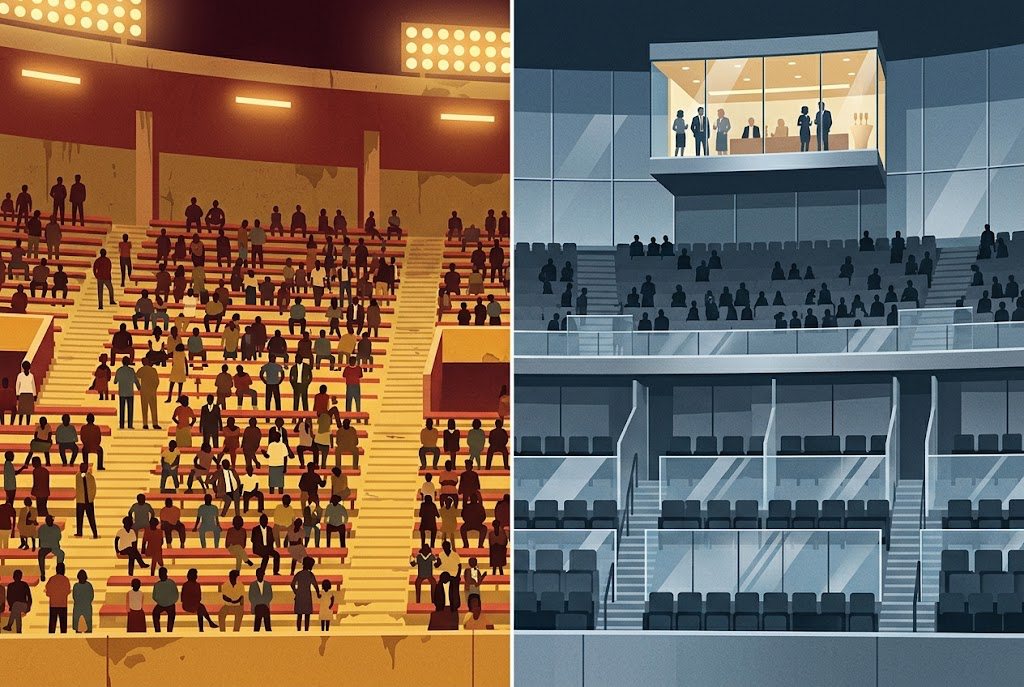
This has already happened elsewhere, and the fans who lived through it are the clearest witnesses to what gets lost. Oakland lost the Warriors to a stadium sliced into private lounges and sequestered luxury sections. It lost the Raiders to Las Vegas, and then the A's followed. One longtime observer of that shift called the replacement model a gated community — three words that do more work than a page of analysis. The new stadiums aren't worse buildings. They're better buildings, built for a different customer.
The pattern repeats with mathematical consistency. In the old stadiums, luxury seating was a small fraction of total capacity, and general admission put rich and poor fans shoulder to shoulder in the same unpartitioned decks. In the new stadiums — SoFi in Los Angeles, the domes in Las Vegas and Brook Park — premium seating still takes up only about 10 to 12 percent of capacity in most NFL stadiums1, but it is priced and segmented the way airlines segment cabins. The price of getting in shows it. At the Browns' new dome in Brook Park, the team's pricing survey floated personal seat licenses, a one-time fee for the right to buy season tickets, running from $550 for an upper-bowl corner seat to $193,650 for a 50-yard-line seat. Final pricing has not been announced2. The number of teams in America hasn't grown in decades. The number of wealthy fans per team has grown enormously. Owners noticed, and the business changed to match — not because they broke any rule, but because the math simply started favoring a smaller, richer pool of customers over a larger, poorer one. The working-class fan base didn't get out-competed. It got deprioritized, on purpose, because it had become the less profitable option.
The Same Machine, Different Rooms
This is not unique to football. It's the same machine running in every room this pattern touches, and economists have started giving that machine a name: the K-shaped economy. Picture the letter itself — one line angling up, one angling down, from the same starting point. Businesses across sectors are restructuring around that shape on purpose, abandoning the broad middle market to chase the smaller top-decile line, because yield per customer now beats volume across customers as a strategy. It isn't an accident of the market. It's the strategy.
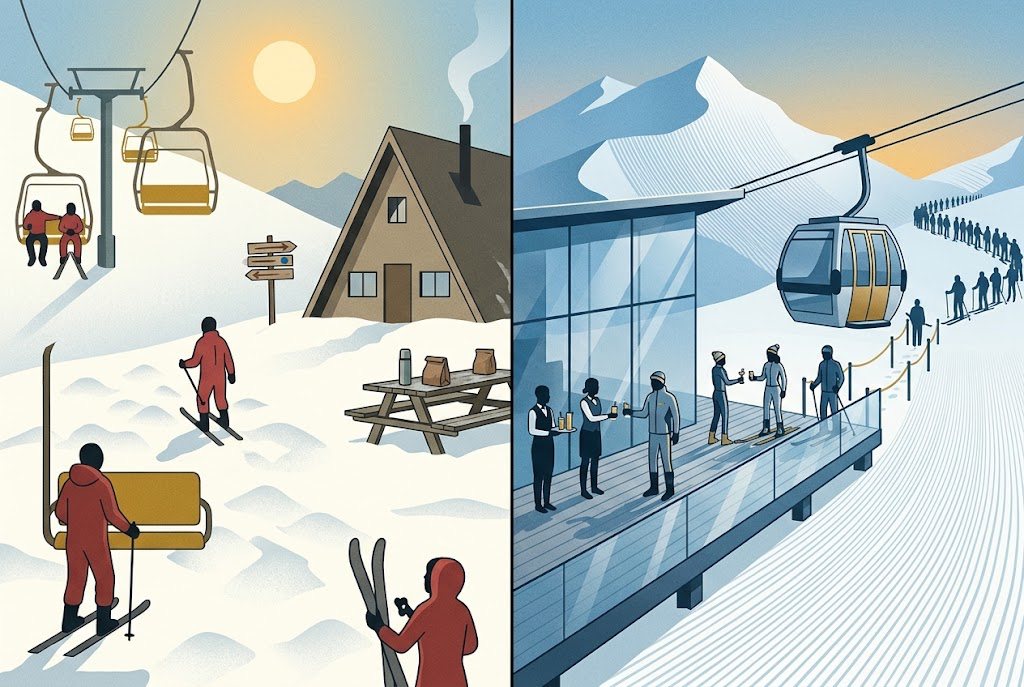
Skiing shows the mechanism at its most naked. Two companies, Vail Resorts and Alterra Mountain, have consolidated ownership and partnership access to more than 93% of North America's extra-large destination ski areas through their Epic and Ikon megapasses. Single-day lift tickets at marquee mountains have been pushed past $350, a price high enough that federal antitrust suits filed in 2026 allege it exists specifically to coerce skiers into $1,000-plus season passes rather than to reflect the actual cost of a lift ticket. The casual, once-a-year family skier — the exact customer who used to be the sport's base — is the customer this pricing is designed to exclude.
Home insurance premiums rose about 47% between 2020 and 2025 for a standard policy3, and an estimated 12% of homeowners had no coverage at all as of 2022. Risk that used to be pooled across a wide base is being repriced onto the individual homeowner: private insurers have pulled back in California, Louisiana, and Florida, and the state insurers of last resort that fill the gap now cover more than $1 trillion in assets4. Ticketmaster is accused of running the identical extraction three separate times on a single ticket: once at the original sale, once when a broker resells it on Ticketmaster's own secondary market, and once more when a fan buys that resold ticket back — generating over $16 billion in disclosed fees over five years, on top of algorithm-driven surge pricing that has turned former general-admission space at concerts into corporate hospitality tiers. The price of Disney's most expensive one-day ticket at Walt Disney World roughly doubled, from $105 at Magic Kingdom in 2015 to $209 for peak dates in late 2026, while the cheapest one-day ticket rose about 23%5. The free FastPass system gave way to paid Lightning Lane options beginning in 20216. Speaking to a Morgan Stanley investor conference in March 2023, CEO Bob Iger said, "In our zeal to grow profits, we may have been a little bit too aggressive about some of our pricing"7. The pricing power has held: the Experiences segment earned about $10 billion in operating income in fiscal 2025, up 8%, with domestic per-guest spending up 5% while attendance slipped 1%8. Youth sports, once a shared community tradition, is now a business that American families fund to the tune of an estimated $30 to $40 billion a year9, and private equity has been consolidating it piece by piece. KKR bought Varsity Brands, the cheerleading and apparel company, in 2024 in a deal reported at $4.75 billion10. BPEA EQT bought IMG Academy from Endeavor for $1.25 billion in an all-cash deal that closed in 202311. Waud Capital took a majority stake in the team-management app TeamSnap in 202112. Genstar Capital-backed Stack Sports acquired the league software company PlayMetrics in 202513. GTCR's portfolio company Ascent Sports Group bought the amateur-sports streaming service LiveBarn in 2026 in a deal reported at roughly $400 million14. Unrivaled Sports, formed by 76ers and Devils owners Josh Harris and David Blitzer, holds a majority interest in Ripken Baseball and the Cooperstown tournament venue, bought the Diamond Nation baseball complex in New Jersey and the soccer event operator YTH Sports in 2024, and in 2025 raised $120 million in a round led by Dick's Sporting Goods15. And Brand Velocity Group bought RCX Sports, the operator behind NFL Flag and Jr. NBA, in 202616. Dick's Sporting Goods, which led the Unrivaled round, also runs its own youth sports business and reports on it in its annual filing: it says its GameChanger youth sports app has about 9 million active users and passed $100 million in revenue in fiscal 202417. S&P Global Market Intelligence counted $2.11 billion of private equity and venture capital investment in amateur sports in the first five months of 2026 alone, a second straight year of growth18. Capstone Partners, an M&A advisory firm, counts 30 private equity deals in sports technology through August 2026, up 25% from a year earlier, and 25 of them were add-ons to companies a fund already owns19. The cost does not land evenly on families. The average family spent $1,016 on one child's primary sport in 2024, up 46% since 2019, and only about one in six sports families said their child plays in a travel or club league20. For those travel families, a tally of published club fees, lessons, camps, and travel puts the bill at roughly $2,000 to $8,000 a year in baseball, AAU basketball, and all-star cheer, and above $10,000 at the elite level.
Different sectors. Same shape. An asset that used to be an egalitarian civic good — a stadium, a mountain, a hospital system, a childhood pastime — gets run through a yield-maximization strategy until access to it becomes a luxury good, and the people who could always afford it before get quietly priced out by design, not by accident. Some sports sociologists have started borrowing Cory Doctorow's term for this pattern in tech platforms — enshittification — and applying it here: lock in a loyal base first, downgrade what was once broadly accessible, then redirect the freed-up resources toward extracting maximum yield from whoever's left who can still pay. Whatever you call the mechanism, the outcome is the same K-shape, sector after sector.
Housing, Cars, College, and Paychecks: The Same K
None of this stays contained to leisure spending. The same shape shows up in the four expenses that actually determine whether a family gets ahead or falls behind, and by late summer 2026 economists were tracking all four using the identical vocabulary.
Housing split cleanly into two markets running in opposite directions. Starter homes — the lowest-priced third of the market, worth about $202,000 nationally — saw sales fall even as inventory grew, because entry-level demand itself is drying up under the weight of everyday inflation and mortgage rates near 6.75%. Luxury homes, the top 5% of the market at roughly $1.9 million and up, saw sales rise as much as 20% over the same stretch, propped up by cash buyers whose wealth sits in a record stock market and never touches a mortgage rate at all. One housing economist described the entry-level pullback as an outright exodus of demand — not higher prices pushing buyers out, but buyers disappearing from the market before a sale is ever attempted.
Cars tell an almost identical story through a different mechanism: manufacturers simply stopped making the cheap option. In 2017, American buyers could choose from roughly three dozen new models priced under $25,000. By 2026 that list has collapsed to four or five, and for the first time in history no new car in America sells for under $20,000. The Chevy Sonic, Ford Fiesta, Hyundai Accent, Honda Fit, Nissan Versa, Kia Rio, Mitsubishi Mirage — the entire entry-level tier — has been discontinued, not because nobody wanted them, but because automakers make more margin on a mid-trim SUV than a stripped-down sedan, and every dollar of production capacity now chases the more profitable customer. The average new car costs nearly $50,000. The average monthly payment is pushing past $700 and climbing.
Higher education is bifurcating the same way, though the mechanism is a demographic cliff rather than a deliberate pricing strategy. Flagship public universities and elite private schools are holding or growing enrollment, sitting on enormous endowments, and largely maintaining selectivity. Small, tuition-dependent regional and private colleges — the schools that have historically served working- and middle-class students closest to home — are closing at a rate of dozens per year, with over 400 more flagged as being at moderate to significant risk over the next decade. The list price at those surviving mid-tier schools has also become close to fictional: nine in ten first-time students now receive some discount off sticker price, with the average discount over 55%. That's not generosity. It's the same opacity-as-strategy that shows up in Ticketmaster's fees and PSL pricing — nobody actually knows the real price until they're already committed to the transaction.
And underneath all three sits the paycheck itself. For the first time since data collection on this began over a century ago, the wage premium that a college degree used to guarantee has gone into sustained decline, as AI absorbs a growing share of the white-collar tasks that premium used to be paid for. The new dividing line isn't degree versus no degree — it's whether a worker uses AI as a tool or gets replaced by one, and workers who've made that leap are commanding wage premiums approaching two-thirds higher than peers doing identical jobs without it. Layered on top, one recent read of Bank of America wage data found higher-income households posting wage gains nearly three times larger than middle- and lower-income workers over the same year — the widest gap in a decade.
Put those four together and the picture stops being about ticket prices and lift passes. Housing, transportation, education, and the paycheck itself are the four costs that decide whether a family can build equity at all — and every one of them is now splitting the same way the stadiums did: fewer, richer buyers on one branch, a shrinking, straining majority on the other, with less and less built in the middle to connect them.
Why "Capitalism" Isn't the Right Word for the Cause
It's tempting to call this capitalism doing what capitalism does. But that framing gives the mechanism a moral status it doesn't have and doesn't deserve — capitalism is neither the villain nor the excuse. Capitalism is a tool. Like a tree — the fruit it bears depends entirely on what's feeding the roots. And the roots, always, are people. Every dollar of capital, stripped of whatever fund or bank or market wrapper it's traveling in, started as somebody's decision not to spend today. A pension fund's capital is a retired teacher's deferred paycheck. A private equity fund's capital is an endowment's or a wealthy individual's money, aggregated and handed a return mandate by a manager standing between the two. The clock that squeezes a youth sports league or a stadium deal into extraction isn't an abstract market force. It's the aggregate expectation of the actual people whose money is sitting in that fund.
Which means the deeper question was never "capitalism versus something else." It's: who gets to set the terms of the transaction, and how far removed are they from the people who live with the consequences? A neighbor lending you money enforces restraint through relationship. An anonymous LP pool fifty layers removed from a pension holder enforces nothing at all, because there's no relationship left to enforce it through. Somewhere between the local bank and the global fund, capital stopped coming from people you could see and started coming from people rendered completely abstract — and abstraction is what let the extraction stop needing to hide.
There's a second layer underneath the financial one, and it's psychological. A hundred years ago, Edward Bernays took his uncle Sigmund Freud's theory of unconscious motivation and used it to move American consumption from a need economy to a want economy — teaching people to buy based on identity and status rather than necessity. That shift is what makes the $150 theme park ticket and the personal seat license feel normal rather than predatory: people were conditioned, over generations, to accept status-tiering as the natural order of things rather than as something that was sold to them.
What We Owe the Not-Yet-Born
There's a version of this story that's easy to miss because it isn't happening to anyone alive to complain about it yet.
Ford and GM used to just make cars. Luxury lived somewhere else — a Cadillac, a Lincoln, a separate lane most buyers never crossed into. The mainstream brand wasn't "affordable" as a market position. It was simply the product, sold to whoever needed one. What's changed isn't that luxury exists. It's that the mainstream brands climbed the ladder themselves, because the same math that makes a $350 lift ticket more profitable than a $50 one makes a $60,000 SUV more profitable than a $20,000 sedan. Nobody out-competed the entry-level car. The manufacturers that used to make it walked away from that buyer on purpose, because their shareholders will always reward the climb.
Which raises the obvious question: who fills the gap they left? Right now, nobody. There's no new manufacturer stepping in, because any company that got big enough to try would answer to the same shareholders demanding the same returns, and would climb the same ladder the moment it could. The only thing left standing in the gap is the used car market — meaning the affordable car hasn't been solved. It's been aged. The buyer priced out of new cars isn't getting a cheaper new option. They're getting someone else's five-year-old car, at a price that's climbing too, just more slowly.
That's the part of this that doesn't resolve in a single election cycle or a single generation's lifetime. A car that never gets built cheap doesn't just cost this year's buyer. It means there's nothing aging into an affordable used car ten years from now either. A starter home that never gets built doesn't just price out this year's first-time buyer — it means the starter-home stock a decade from now is even thinner than it is today. Every discontinued entry point compounds forward, onto people who haven't been born yet to inherit whatever's left.
Capitalism, left alone, was never going to correct for that on its own — not because it's malicious, but because a system doesn't develop a conscience unless somebody builds one into it by design. Systems don't grow a soul. People do, and only if the system was built to let them. Capital comes from people, but people aren't capital — people are the resource capital gets extracted from and, if the design is right, reinvested back into.
Prosperitism: A Different Root System
If the tree metaphor holds, then the fix isn't a new set of regulations bolted onto the same root system — it's a different root system entirely, one where responsibility to the other party isn't imported after the fact but built into the mechanism from the start. To paraphrase Buckminster Fuller, the architect, inventor, and systems designer best known for the geodesic dome: you never change something by fighting the existing reality — you change it by building a new model that makes the existing one obsolete.21 He made the point decades before there was a name for what it might replace. That's Prosperitism. Not capitalism regulated into behaving. Capitalism's profit motive, retained, running through a model the extraction-based version simply can't compete with once it exists.
Every attempt at something like this has run into the same failure. DEI and ESG both asked people to trust a diffuse, long-term societal benefit in exchange for a concrete, short-term cost — compliance overhead, hiring friction, reporting burden — and that is a losing psychological trade. It asks for sacrifice now and delivers an abstraction later, which is exactly backwards from how Bernays taught an entire economy to sell things. Prosperitism can't make that mistake. The payoff has to be immediate and felt by the individual at the point of the transaction — not a promise about the world in twenty years, but something real the person walks away with today. The philosophy does its work underneath the purchase, not as the pitch itself.
Concretely, that means the shared-responsibility mechanism has to live on both ends of the capital chain, not just one. On the investor side, that could mean labeling capital by its source and its patience — pension capital, family capital, retained-earnings capital, fast-clock private equity capital — each with a disclosed cost-of-capital and a measurable ratio of profit reinvested into the people the business serves versus profit distributed upward. On the customer side, it means the seller commits to transparent, all-in pricing with no bait-and-switch fees at checkout, and the buyer, in turn, chooses the business because of what that choice makes them, not just what it gets them.
Obsolete, Don't Compete
That standard is a much harder bar than reform, and it's worth being honest about why. Reform accepts the incumbent's board and tries to win a better position on it — a price cap, a new regulation, a union contract, a lawsuit. Every one of those still leaves the underlying game intact, still leaves the incumbent free to route around the new rule the moment enforcement looks away. Obsoleting the incumbent means building something the old model literally cannot compete with on its own terms, because the terms themselves no longer apply.
That reframes the entire question the Luxe Economy poses. You cannot out-negotiate a private equity fund for a bigger discount on a youth sports league it already owns. You cannot out-lobby a monopoly sports league for a fairer PSL structure. Scarcity-based extraction only works as long as the scarce thing stays the object everyone wants. The Fuller move isn't to fight for a cheaper seat inside the stadium. It's to build something so genuinely better that fewer people care whether they ever get inside at all.
The same test applies to each of the sectors laid out above, and it plays out slightly differently depending on what kind of moat the incumbent is actually standing on. Where the moat is manufactured scarcity — a stadium, a mountain, a theme park — the obsoleting move has to make an entirely different kind of access desirable enough that the scarce thing stops being the prize people are chasing. Where the moat is a credential — a college degree, a professional pedigree — the obsoleting move has to build a new signal trustworthy enough that employers and institutions start reading it in place of the old one, particularly at the exact moment the old signal is already losing its value on its own. Where the moat is the capital structure itself — a PE fund's return mandate, a public market's quarterly clock — the obsoleting move has to make patient, shared-responsibility capital an actual investable option, not just a preferred description, so restraint has somewhere real to live instead of remaining a value someone has to be talked into.
You never change something by fighting the existing reality. You change it by building a new model that makes the existing one obsolete.
Inspired by Buckminster FullerDon't fight head on. Out-build them.
None of that requires the alternative to ask anyone for a sacrifice. That's the actual Fuller test, and it's a stricter one than it sounds: does the new model need the customer to feel virtuous to choose it, or does it just need to be better, on its own terms, the first time they try it? A model that requires moral persuasion to compete is still competing — still fighting the old reality for market share one convert at a time. A model that simply works better doesn't need anyone's permission to spread. It obsoletes the incumbent by making the old choice look strange in hindsight, the way a rotary phone looks strange now — not defeated, just no longer relevant to what anyone is actually trying to do.
It's not a fully worked system yet. It's an argument, and arguments are supposed to be tested against a reaction before they're finished. But the diagnosis holds regardless of where the solution lands: America isn't drifting into two separate economies. It has built one economy with a pump in the middle, and the Despair Economy — 268 million people large — is what's keeping the smaller, Luxe end of the pipe running.
The Muni Lot has eighty years of history in it. It has none in the balance sheet of the stadium going up down the road.
The question underneath everything this piece has argued is really about custody: do the people running this system today owe something to the people who will have to live inside whatever's left of it, long after the current shareholders have taken their return and moved on?
That question is bigger than one essay can carry, and it deserves its own. This one has been about naming the pump. A companion piece is owed to the people standing on the other side of it, who haven't been born yet to ask.